Emma Dawson
Monday, 16 March 2026
Emma Dawson
Monday, 16 March 2026
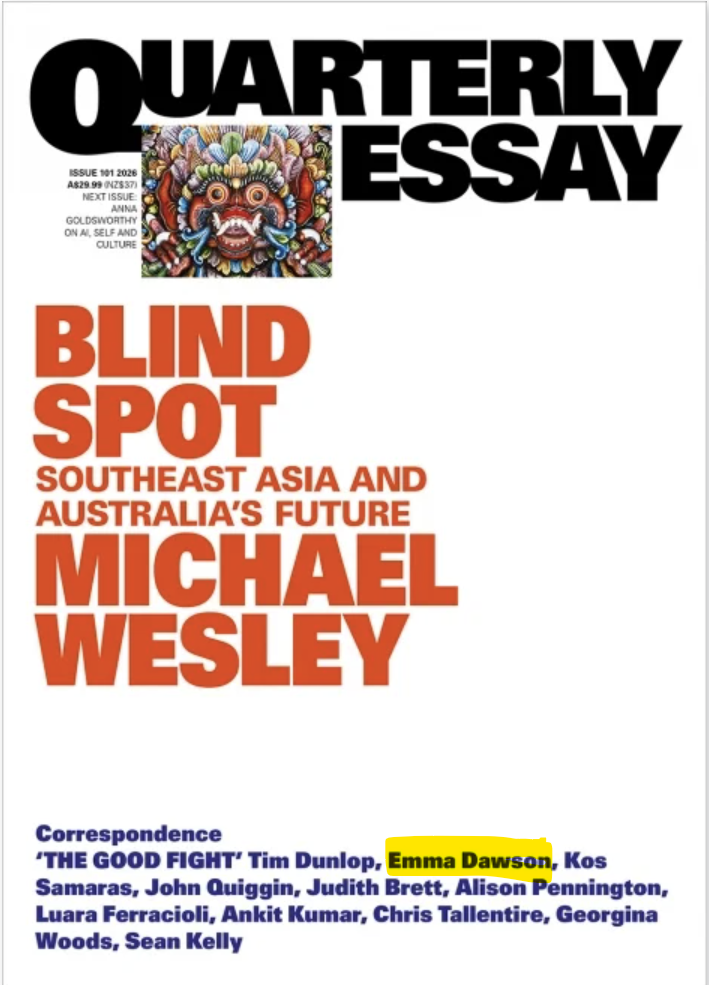
Sean Kelly poses a fundamental question in his Quarterly Essay: what do our political leaders believe? It is a question usually absent from Australia’s civic conversation, which is dominated by a shallow obsession with the “horse race” of political contest. By contrast, Kelly’s reflection on the principles and practice of the Australian Labor Party is thoughtful and nuanced. It is also suffused with frustration about Labor’s performance in government since 2022, reflecting an increasingly common view among Australians who are both progressive in outlook and highly engaged with politics: that Albanese is too timid, not ambitious enough for the nation; that he is shirking the great moral responsibility Labor has always carried: “to change things on behalf of those who desperately need them to change.”
The reason for Kelly’s frustration is articulated towards the end of the essay, where he deftly outlines the global impact of decades of neoliberal economics, which has led to levels of inequality rivalling those of the late nineteenth century in developed nations. At the same time, and not coincidentally, politics has become highly polarised, and society more fractured. The civil unrest in the United States, UK and Europe resembles that of the 1930s, and Australia – long considered safe from the kind of violence that has characterised older nations – has now experienced a devastating, ideologically motivated terrorist attack at Bondi Beach, the very definition of “home soil.”
This, Kelly argues, is the time for a bold, left-wing politician to fight for social justice. He is sceptical that Albanese has that “good fight” in him, comparing his approach unfavourably with the grand rhetoric and revolutionary social change of Whitlam and, most damningly, with the “risk that excites” reformist style of the Hawke/Keating years.
Kelly’s thesis is that by declaring an ambition to become “the natural party of government” and stating his belief that Labor “stand[s] for the vast majority of interests in this country,” Albanese has abandoned Labor’s role as the party of reform. His ambition, Kelly suggests, is little more than a cipher for being “all things to all people” and means that the major parties’ positions have reversed, with Labor now playing the role of conserving the status quo.
This is where an otherwise excellent essay goes wrong.
Kelly’s thesis rests on the idea that the Australian Labor Party identifies itself primarily in opposition to the dominant Liberal–National Coalition – that it is “a party shaped around countering the right.” This argument rests on flimsy ground: a claim by historian Brian McKinley that the ALP, in its early years, was little more than “a coalition of disparate elements … linked … by hostility to Australian conservatism.” And so, Kelly asks, if Labor is no longer by definition “not the Liberal Party” then just what is the ALP today?
But this definition of Labor is wrong – he has it back to front. Labor is the party against which other movements in Australia are set, not the other way around.
Before World War II, Australia’s parliament was populated by members of the Australian Labor Party, which has existed since before Federation, and an ever-changing suite of conservative parties that were, before they had any coherent platform of their own, defined primarily in opposition to Labor. (Indeed, in the weeks since The Good Fight was published, this history has been thrown into full view, as the Coalition has separated again into its disparate parts, while other right-wing forces cannibalise conservative voters, and populist politicians begin to break bread with One Nation.)
This fundamental misunderstanding of the ALP undermines Kelly’s critique of Albanese and stymies his ability to see clearly what Labor is doing in government. Kelly’s failure is to understand the purpose of Labo(u)r as a movement that, as Albanese told the UK Labour Party Conference in September 2025, “chose democracy” as the path to social reform. In fact, the word “purpose” is almost entirely missing from Kelly’s essay, when in fact it is purpose rather than belief that drives the labour movement and informs the policies and actions of the Labor government.
From its earliest days among the sheep shearers of Barcaldine and the revolutionaries of the Eureka Stockade, the Australian labour movement was concerned with the quotidian demands of working people. The origins of the Australian Labor Party rest on organised labour and the collective decision to build, from a grassroots movement for workers’ rights, a political party that could utilise the power of Parliament: the culmination of a movement that sought not just to protest the laws of the ruling class but to change them.
This origin story is markedly different to that of the lofty idealism of democratic liberalism in the United States that created the Democratic Party from a branch of the Jeffersonian Republicans. There are also key differences in the way Australian Labor entered electoral politics to the path taken by its British sister party. The ALP was, by virtue of demographics, led determinedly by working people and far less prone to the influence of the Fabian socialism espoused by the Victorian cultural elite.
It is true that Labor is Australia’s party of reform. Throughout our history, it has been Labor that has taken the public policy initiatives that shape and define the Australian way of life. From full employment and the creation of a robust welfare state in the postwar years, through the design of the Pharmaceutical Benefits Scheme and our once-world-leading vocational training system, to the establishment of universal healthcare and superannuation, the building of the National Broadband Network and the invention of the National Disability Insurance Scheme – it has been Labor governments that have undertaken the great, nation-building programs that create wealth and wellbeing for the majority of people.
It has done so patiently and methodically: for example, the pursuit of universal healthcare did not start, as Kelly claims, with Whitlam, but with Curtin and Chifley. It took Labor forty years to implement and secure Medicare. This slow and dogged pursuit of reform has always been central to Labor’s way of governing.
It is this that Albanese has in mind when he says, “we represent the vast majority of interests in this country”: his conviction that, despite decades of social atomisation and economic plunder under increasingly reactionary neoliberal rule, Australians still value the collective achievements that set Australia apart from other established democracies, and the fact that they were achieved through policy and persuasion, with a minimum of social conflict.
For, despite the wailing of the progressive cultural class, Australia is a more left-wing country than most English-speaking democracies, largely by virtue of strong democratic institutions and laws, most often enacted by the ALP. It is not just our universal health and superannuation systems that are the envy of the world: Australia was the first country to establish the concept of a minimum wage, led the world in the achievement of the eight-hour day, and was one of the first countries to legislate equal pay for women. Most young Australians are shocked to hear that it was the Blair Labour government that first legislated a legally binding minimum wage in the UK – in 1999.
Australia’s egalitarian culture rests on this history of rights and institutions fought for by, and directed to the welfare of, working people. Albanese understands this history of purpose and, more importantly, knows that the majority of non-Indigenous Australians share a view of the country as one of opportunity. Whether descended from miserable convicts brutalised by the British ruling class or from an immigrant or refugee seeking to build a better life, settler Australia has been a great experiment in genuine freedom for people who started life with little and sought to build security and prosperity through opportunity and effort.
The actions of the Albanese government sit squarely within this traditional purpose of providing and protecting opportunity and ensuring that national prosperity is shared – not through revolutionary means, but by careful reforms enacted through government.
Kelly claims to find the lists of achievements sometimes posted online by supporters of the ALP unconvincing, which is perhaps why he doesn’t bother to identify the common purpose behind those achievements. Fair enough: that’s really the job of politicians. Yet by focusing on what Labor has done rather than on its rhetorical emphasis on caution and consensus, an astute observer of Albanese’s government would recognise a clearly social-democratic program of reform.
Industrial relations changes have been significant and far-reaching: for the first time in a decade, the labour share of national growth is rising and real wages are increasing. Wage increases for essential workers in the care sector are being delivered, as are increased hours of early childhood education and care for children of all backgrounds. Free TAFE is supporting young people to gain useful qualifications that will enable them to pursue careers in a post-carbon Australia. Industry policy is being enacted to create those jobs of the future and decarbonise the economy. Social housing is being built and a vehicle for its long-term funding has been established. Treasury is broadening its scope to consider other measures of wellbeing beyond GDP, and inflation has been reduced without an increase in unemployment. The most egregious abuses of the welfare system are being addressed, not least through the rapid reversal of cuts to single parenting payments in Jim Chalmers’ first budget. Young people without the “bank of mum and dad” are being supported into home ownership. The NBN will remain in public ownership. The national electricity grid is being upgraded for renewables and households supported to switch to solar. The destruction of progressive income taxation was reversed, and Australian children are no longer exposed to the manipulative and harmful algorithms of social media platforms. And record investments in Medicare along with the creation of urgent care clinics have begun to restore the promise of universal healthcare that is free at the point of delivery.
Many of the measures implemented qualify as pre-rather than re-distributive and, as such, are clearly labourist in ideology. That is, they are aimed at giving people opportunity and agency in an increasingly unequal world, rather than being satisfied with distributing the spoils of our common wealth through the welfare system.
The policies legislated and implemented since May 2022 have begun to reverse the more damaging effects of the neoliberal economic order, but the challenge of creating a new structure to replace it is a long-term project.
Albanese surely knows this and is cognisant that Labor is in power at a time of real social and economic disruption across the world, one not seen for almost a century. It is in this context that he seeks to govern cautiously and inclusively, listening to all Australians, not just the loudest voices from right and left.
Keating’s “risk that excites” may appeal to progressives who live comfortable lives, but risk is only exciting to those who either can afford to take it or have nothing to lose if it fails. Most Australians in 2026 are wary of risk, and of politicians who promise – or threaten – big change. Unlike the hollowed-out working classes in the north of England or America’s rural south, Australian working people still have something – largely thanks to Labor’s efforts to ameliorate the worst effects of neoliberalism in the 1980s – to lose. They have voted for change, but to proceed with caution. Albanese is heeding their call.
Emma Dawson